Observations of Exocomets
Korth, Norazman, Bendahan-West et al. — Space Science Reviews, 2026
We present an up-to-date review of observational techniques for detecting exocomets, the small-body analogues of Solar System comets in other planetary systems. Starting from the well-studied case of β Pictoris, we discuss photometric transit searches, which exploit the asymmetric light curves produced by cometary dust tails, and spectroscopic methods that track time-variable gas absorption features. We summarise progress in both individual system studies and large-scale surveys, and highlight persistent open questions around physical properties, occurrence rates, and the degree of similarity to Solar System comets. This chapter is part of a collection on exocomet science published in Space Science Reviews, available here.

JWST/MIRI coronagraphic search for planets in systems with gapped exoKuiper belts and proper-motion anomalies
Bendahan-West et al. — MNRAS, 2026
We use JWST/MIRI coronagraphic observations as part of program GO 1668 to search for planets sculpting gaps in three exoKuiper belts: HD92945, HD107146, and HD206893. The observed gapped structures suggest the presence of unseen planets carving a gap through direct clearing or resonant planet-disc interactions. We reduce MIRI coronagraphic 11.4µm observations using spaceKLIP, and compare the images with archival data to investigate the nature of the detected sources. We build detection probability maps (DPMs) using MADYS, which quantifies the detection probability of a planet at a given deprojected separation from the JWST contrast curves. We describe new regions that can be overplotted onto the DPMs such as proper motion anomaly constraints, which ultimately enable us to constrain the planetary architecture responsible for the disc structures.

ARKS V: Comparison between scattered light and thermal emission
Milli, Olofsson, Bonduelle, Bendahan-West et al. — A&A, 2026
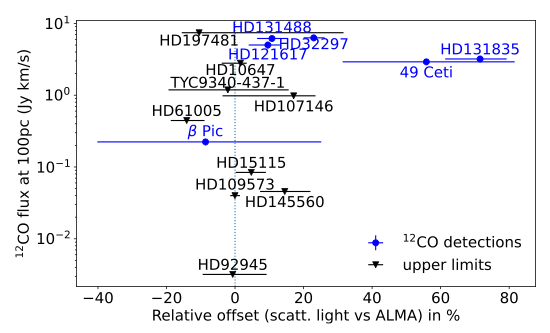
As part of the ARKS large programme, we present a comprehensive multi-wavelength analysis of debris-disc dust grain distributions. We compare scattered-light and thermal emission observations for 15 of 24 debris discs. In six systems, we find striking grain-size segregation, with micron-sized particles extending significantly beyond millimetre grains. These spatial offsets are strongly associated with residual CO gas. Where gas is absent, radiation pressure alone explains the displacement, as expected. We show that gas preferentially displaces small grains, making it a key dynamical driver of debris-disc structure alongside planetary interactions.
ARKS I: Motivation, sample, data reduction, and results overview
Marino et al. — A&A, 2026
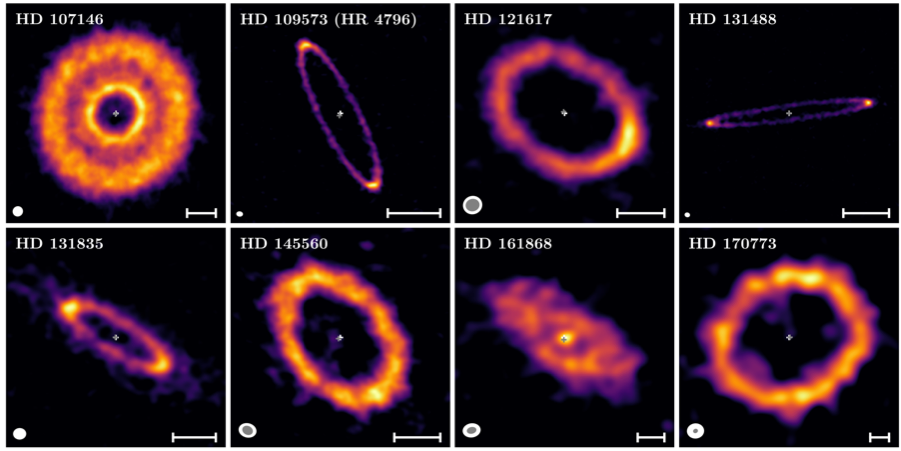
We present ARKS (the ALMA survey to Resolve exoKuiper belt Substructures), the first ALMA large programme dedicated to debris discs, targeting 24 exoKuiper belts at high angular resolution to characterise their radial and vertical structure, asymmetries, and gas content. The survey uncovers a remarkable diversity of substructures: up to a third of belts show multiple dusty rings, asymmetric features are widespread, and vertical profiles vary significantly across the sample. In gas-rich systems, CO is not always collocated with the dust, and in at least one case non-Keplerian kinematics point to a pressure-driven vortex trapping dust in an arc. Together, these results establish the statistical foundation needed to distinguish between planetary sculpting, collisional evolution, and gas-driven processes in the outer regions of planetary systems.
JWST/NIRCam observations of HD 92945 debris disk: An asymmetric disk with a gap
Lazzoni, Bendahan-West et al. — A&A, 2025
We present the first JWST/NIRCam coronagraphic observations of the HD 92945 debris disc at 2 and 4.4 μm. The disc shows a broad, inclined structure with a gap at ~80 au and a prominent brightness asymmetry in the southwestern inner ring—consistent across multiple wavelengths and epochs, including previous ALMA and HST observations. While no planetary companions are directly detected, our contrast limits exclude Jupiter-mass planets beyond 20-40 au and rule out a single distant planet as the source of Gaia's astrometric signal. Combined with the observed disc features, our results support a scenario where one or more sub-Jupiter planets interior to 20 au dynamically sculpt the disc through secular resonances, explaining the gap, asymmetry, and astrometric acceleration.

Follow-up Exploration of the TWA 7 Planet─Disk System with JWST NIRCam
Crotts et al. — ApJ, 2025
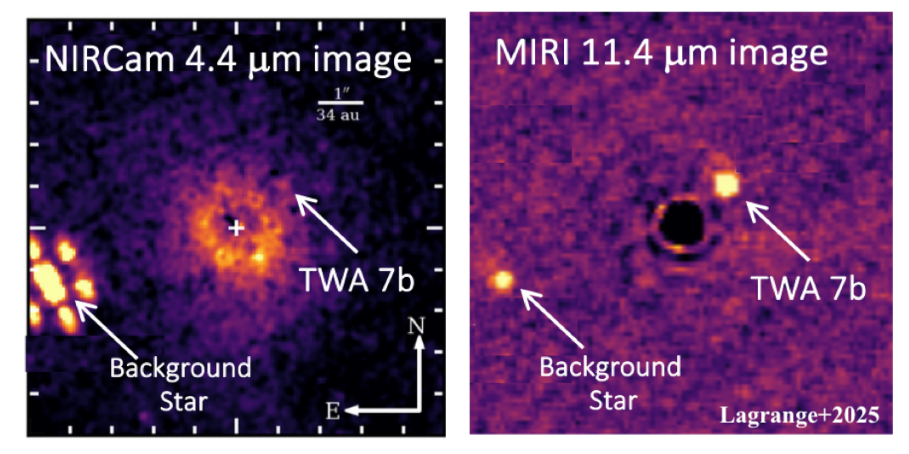
We present JWST/NIRCam F200W and F444W observations of TWA 7, targeting a planet candidate previously identified with JWST/MIRI at 11 μm within a gap in the system's debris disc. A coincident point source detected in F444W confirms the MIRI candidate, making TWA 7 b the first planet directly detected within a debris disc gap and establishing a rare direct link between disc sculpting and planetary presence. Our imaging also recovers disc substructures hinted at in earlier scattered-light observations, including an underdensity at the planet's orbital location and evidence for co-orbiting material, similar to Jupiter's Trojan population.
Quantifying spectroscopic Ca II exocomet transit occurrence in two decades of HARPS data
Bendahan-West et al. — MNRAS, 2025
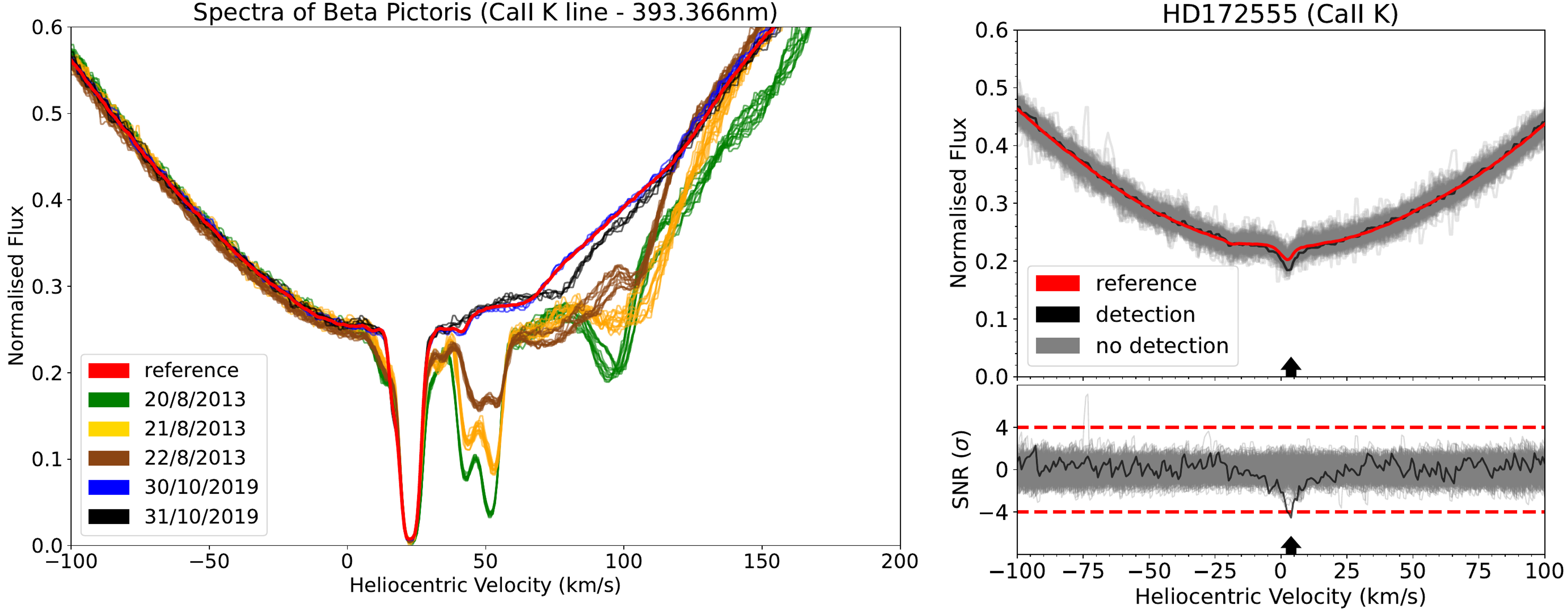
As part of my Master's, we developed a pipeline that searches for signs of exocomet transits in spectroscopy data. Being guided by the multiple exocomet transits detected around the archetypal star Beta Pictoris, exocomets can be identified by transient absorption features in specific atomic species, such as the commonly used ionised Calcium doublet. We aimed to overcome previous sample selection biases, and use the entire HARPS archive to build a large and diverse sample of stars. Ultimately, we estimate the occurrence rate of exocomet transits in HARPS and determined any trends in exocomet host stars.
No papers match the current filters.